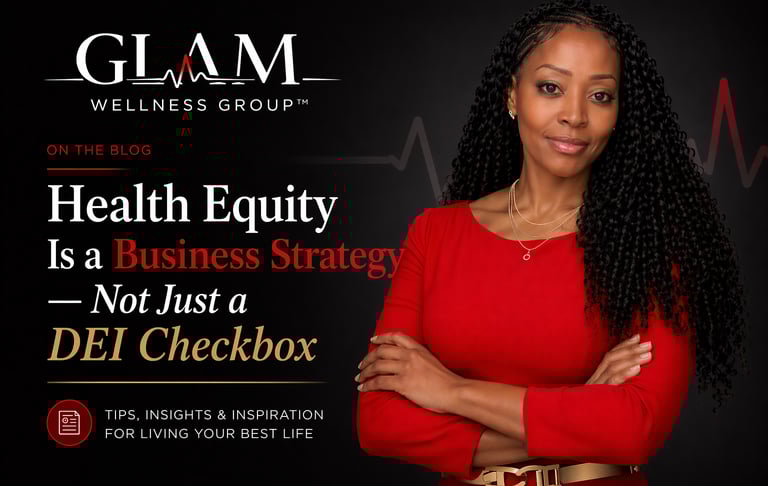
Health Equity Is a Business Strategy — Not Just a DEI Checkbox
Health equity isn't a diversity initiative. It's a business imperative — and organizations that understand this will have a significant competitive advantage.
Dr. Tamika Quinn, Your Favorite Stroke Survivor™
4/23/20265 min read
Health Equity Is a Business Strategy — Not Just a DEI Checkbox
By Dr. Tamika Quinn | Your Favorite Stroke Survivor™
Category: Workforce Health & Health Equity | Read time: 5 minutes
Let’s have an honest conversation.
When most organizations talk about health equity, they file it under DEI. They mention it in the annual report. They highlight it during Black History Month or Hispanic Heritage Month. They nod along when the topic comes up in leadership meetings.
And then they go back to offering the same wellness program they’ve always offered — designed for the same default employee they’ve always imagined — and wonder why the health outcomes across their workforce remain unequal.
Health equity is not a diversity initiative.
It is a business imperative.
And the organizations that understand this distinction are going to have a significant competitive advantage over the ones that don’t.
📥 FREE DOWNLOAD: The Corporate Wellness Guide
Before you keep reading — grab Dr. Quinn’s free strategic guide to building a healthier, more productive workforce. Download it free here →
What Health Equity Actually Means
Health equity means that every person has a fair and just opportunity to be as healthy as possible — regardless of their race, gender, zip code, income, or background.
It does not mean equal treatment. It means equitable treatment — recognizing that different people face different barriers, and that a one-size-fits-all approach will never produce equal outcomes when the starting lines are not equal.
In the workplace, this looks like understanding that your Black and brown employees are statistically more likely to experience cardiovascular disease, diabetes, and stress-related illness at younger ages. It looks like recognizing that employees in lower-wage roles often have less access to quality healthcare, less flexibility to attend preventive care appointments, and higher baseline stress loads.
It looks like asking: Is our wellness strategy actually reaching everyone? Or just the people who already have the most resources?
💚 Cardiovascular disease is the leading cause of death for Black Americans. Knowing your numbers saves lives. The OMRON Platinum is the #1 doctor-recommended home blood pressure monitor — an essential first step in closing the cardiovascular health gap →
The Business Case Is Undeniable
I know some leaders get uncomfortable when the conversation turns to race and health. So let me bring it back to what every organization ultimately cares about: performance, retention, and risk.
Performance:
Employees who face significant health disparities are more likely to experience chronic conditions that affect cognitive function, energy, and output. Addressing the root causes of those disparities — through targeted education, culturally relevant programming, and equitable access — directly improves workforce performance.
Retention:
Employees who feel seen, supported, and valued are more likely to stay. When your wellness strategy signals that you understand and care about the specific health challenges your diverse workforce faces, you build loyalty that no compensation package can replicate.
Risk:
Organizations with significant health disparities in their workforce carry more risk — more absenteeism, more disability claims, more turnover, more liability. Proactively addressing health equity reduces that risk. It is, quite literally, a risk management strategy.
This is not charity. This is strategy.
The Gap Most Organizations Don’t Know They Have
Here is something I see consistently when I work with organizations on workforce health: there is almost always a gap between what leadership believes their wellness program is doing and what employees — particularly employees of color — are actually experiencing.
Leadership sees: a comprehensive benefits package, an EAP, a wellness portal with hundreds of resources.
Employees see: content that doesn’t speak to their cultural context, programs that assume a level of healthcare access they don’t have, and a general sense that the wellness conversation wasn’t really designed with them in mind.
That gap is costly. And it is closeable.
But closing it requires organizations to do something that feels uncomfortable for many: look at their data disaggregated by race, gender, and income level. Find out who is engaging with wellness programs and who isn’t. Ask why — and actually listen to the answers.
📥 READY TO CLOSE THE GAP? START HERE.
The Corporate Wellness Guide gives you the exact framework to build a wellness strategy that reaches every employee in your organization. ⇩ Download The Corporate Wellness Guide FREE →
What Culturally Relevant Health Education Changes
I have stood in rooms — corporate boardrooms, hospital conference halls, community centers, university auditoriums — and watched what happens when people hear health information delivered in a voice that sounds like theirs.
Something shifts.
Not because the information is different. But because the messenger carries lived experience that makes the information real. When I stand in front of a room of Black professionals and tell them that I had two strokes at 27, that I know what it means to push through when your body is screaming stop, that I understand the unique pressures and barriers that shape our health outcomes — the room leans in.
That is not a small thing. That is the difference between a wellness message that gets filed away and one that changes behavior.
Culturally relevant health education is not about making people feel good. It is about making health information accessible, credible, and actionable for populations that have historically been underserved by mainstream health messaging.
It works. And organizations that invest in it see results.
📚 Want science-backed research on why wellness messaging fails certain populations? Burnout: The Secret to Unlocking the Stress Cycle by Emily & Amelia Nagoski is essential reading for every HR leader and wellness advocate →
Moving From Checkbox to Culture
So what does it actually look like to build health equity into your organizational culture — not as a DEI initiative, but as a core business strategy?
It starts with leadership commitment.
Not a statement. Not a slide in a deck. A genuine, visible, sustained commitment from the people at the top to understand and address health disparities within their workforce.
It requires investment in culturally competent programming.
Health education and wellness initiatives that are designed with diverse populations in mind, not retrofitted for them after the fact.
It demands data accountability.
Measuring health outcomes and wellness engagement across demographic groups, and being willing to act on what the data reveals.
And it calls for partnerships with voices and organizations that are already trusted within the communities you’re trying to reach.
This is the work. It is not easy. But it is necessary.
And it is the work I have dedicated my life to — as a stroke survivor, as an advocate, as a speaker, and as a strategist who believes that the health of our communities and the health of our organizations are not separate conversations.
📋 Data accountability starts with tracking. This top-rated wellness habit tracker is a simple, powerful tool for building organizational accountability around health goals →
The Question I Leave Every Room With
At the end of every keynote, every workshop, every corporate engagement, I ask the room one question:
Who in your organization is not being reached by your current wellness strategy?
Not because I want to make anyone feel guilty. But because that question — honestly answered — is the beginning of real change.
Health equity is not the finish line. It is the foundation.
And the organizations brave enough to build on it will be stronger, more resilient, and more human for it.
🎁 FREE: The Corporate Wellness Guide
Get the step-by-step framework to build a health equity strategy that reaches every employee — and moves the needle on real organizational health. → Download Your FREE Copy Now
About the Author
Dr. Tamika Quinn is a two-time stroke survivor, U.S. Navy veteran, 12x published author, and American Heart Association National Spokesperson. She is the founder of GLAM Wellness Group™ and creator of the Health Is Wealth Framework™ — a corporate wellness strategy that positions preventive health as an economic and leadership imperative.
Ready to bring the health equity conversation to your organization?
“Every choice you make today is either building strength for tomorrow… or borrowing from it.”