What Two Strokes at 27 Taught Me About Corporate Health Culture
At 27, three days apart, I had two strokes. What happened to my body is exactly what's happening inside organizations across America.
Dr. Tamika Quinn, Your Favorite Stroke Survivor™
4/23/20265 min read
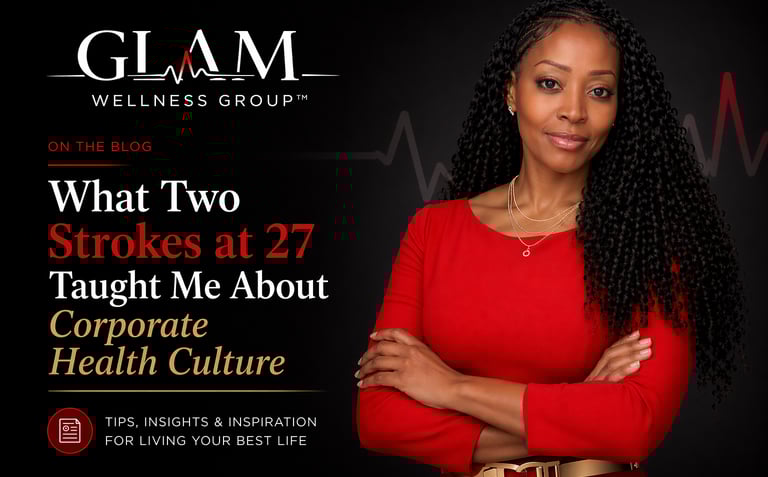
What Two Strokes at 27 Taught Me About Corporate Health Culture
By Dr. Tamika Quinn | Your Favorite Stroke Survivor™
Category: Personal Resilience & Workforce Health | Read time: 6 minutes
I want to tell you exactly what happened to me.
Not the polished version. Not the motivational summary. The real version — because I think the details matter. I think they might save someone’s life. And I think they hold a mirror up to something happening inside organizations across this country that nobody is talking about loudly enough.
It Started With a Baby
I was 27 years old when I gave birth to my daughter. During my pregnancy I developed preeclampsia — a dangerous condition marked by high blood pressure that affects pregnant women and can have life-threatening consequences if not carefully managed.
My blood pressure spiked extremely high during labor and delivery. The medical team kept me an extra day in the hospital after my daughter was born just to get my blood pressure under control. When I was discharged, I was prescribed medication and given clear instructions: take this to keep your blood pressure regulated.
I didn’t take it.
Not because I was careless. Not because I didn’t understand the instructions. But because I was 27 years old. Because I had just had a baby and I believed — the way so many young, otherwise healthy people believe — that my body would correct itself. That the medication was precautionary. That I didn’t really need it.
I thought: I just had a baby. This will go away on its own.
It did not go away on its own.
🧡 High blood pressure has no symptoms until it’s too late. The single most important thing you can do is know your numbers. The OMRON Platinum — the #1 doctor-recommended home blood pressure monitor →
Ten Days Later
Ten days after delivering my daughter, I woke up with a headache unlike anything I had ever experienced. Not a tension headache. Not a migraine. Something deeper, more ominous — the kind of pain that your body uses to signal that something is catastrophically wrong.
As the day went on, my vision began to diminish. Progressively. Quietly. The edges of my world started closing in.
By that evening, my speech was slurred. And I felt something I will never forget — an overwhelming, bone-deep certainty that I was not going to make it.
When I arrived at the emergency room, I lost control of my bladder and passed out.
I woke up several days later in the ICU.
What the Doctors Found
I had suffered a bleed on the right side of my brain. The entire left side of my body was paralyzed.
I was a U.S. Navy Hospital Corpsman — trained to respond to medical emergencies in other people. I had no framework for recognizing one unfolding inside my own body, slowly, over the course of a single day.
Three days into my ICU stay, I suffered a second stroke — this time in the frontal lobe of my brain.
Two strokes. Three days apart. Twenty-seven years old. Ten days postpartum.
I spent three and a half weeks in the ICU.
The doctors told me I would never walk again. That I would need assistance for the rest of my life.
I never believed them.
The Road Back
Through months of intensive rehabilitation — physical therapy, occupational therapy, speech therapy — I rebuilt myself. Not just my body. My identity. My purpose. My understanding of what my life was for.
Today I am fully functioning. I walk. I speak. I stand on stages across the country and deliver keynotes to corporate audiences, hospital systems, universities, and government agencies.
And I have devoted my life to one mission: spreading awareness and prevention of stroke, heart disease, and childhood obesity — with a primary focus on supporting organizations by identifying and reducing the health factors that contribute to low performance, high absenteeism, and preventable crisis.
Because what happened to me was preventable.
That is the part that keeps me up at night.
📥 FREE DOWNLOAD: The Corporate Wellness Guide
What happened to Dr. Quinn was preventable. Is your organization catching the warning signs before they become a crisis? → Download the Free Corporate Wellness Guide
The Warning Signs Were There
I want you to sit with something for a moment.
At every stage of my story, there was a warning sign.
The preeclampsia diagnosis. The blood pressure spike during delivery. The extra hospital day. The prescribed medication. These were not subtle hints. These were clear, clinical signals that my cardiovascular system was under serious stress and needed intervention.
I ignored them — not out of recklessness, but out of the deeply human belief that I was the exception. That the rules of biology applied to other people. That 27 was too young for this to be real.
Now I ask you: how many people in your organization are doing exactly the same thing?
How many of your employees are walking around with uncontrolled blood pressure, dismissing symptoms, skipping follow-up appointments, telling themselves they’ll deal with it later — when things slow down, when the quarter ends, when the kids get older?
How many of them are one ignored warning sign away from an event that changes everything?
💡 Encourage your team to start monitoring their blood pressure at home. Early detection saves lives. Check out the OMRON Platinum — clinically validated, AFib detection, doctor recommended →
What This Has to Do With Your Organization
Everything.
The conditions that contributed to my crisis — unaddressed health risks, the belief that we can push through, the cultural message that our bodies will keep up if our will is strong enough — are not unique to me. They are embedded in workplace culture across America.
We celebrate the employee who never takes a sick day. We normalize chronic stress as the price of ambition. We build cultures that reward output over sustainability — and then we are shocked when people break.
I am not shocked. I am a living example of what happens when warning signs go unaddressed.
But I am also a living example of what is possible when we choose differently.
📚 Want to understand why your high performers are the most at risk? Burnout: The Secret to Unlocking the Stress Cycle by Emily & Amelia Nagoski breaks down the science of why we push through until we break — and what to do instead →
The Framework Built From Survival
The Health Is Wealth Framework™ was not born in a research lab or a business school. It was born in an ICU bed, in a rehabilitation gym, in the long slow process of rebuilding a life that the medical establishment said was over.
It is a structured, evidence-informed approach to workforce health that helps organizations do what no one did for me: catch the warning signs early, build a culture that takes them seriously, and invest in the human sustainability that makes everything else possible.
Because your people are not machines. And the cost of treating them like they are — in human terms, in business terms, in every term that matters — is far higher than any of us can afford.
📋 Culture change starts with daily habits. This top-rated wellness habit tracker helps teams build daily health accountability — one small habit at a time →
The Question I Carry Into Every Room
When I walk into a boardroom or onto a conference stage, I carry this question with me:
What warning signs are you ignoring right now?
Not as an accusation. As an invitation.
Because I know what it costs to ignore them. I paid that price personally. And I have made it my life’s work to make sure as many people as possible — and as many organizations as possible — never have to pay it.
The warning signs are there. They are always there.
The only question is whether we choose to act on them in time.
🎁 FREE: The Corporate Wellness Guide
Get Dr. Quinn’s step-by-step framework to help your organization catch the warning signs early — and build a culture that actually supports human sustainability. → Download the Free Corporate Wellness Guide Now
“Every choice you make today is either building strength for tomorrow… or borrowing from it.”
About the Author
Dr. Tamika Quinn is a two-time stroke survivor, U.S. Navy veteran, 12x published author, and American Heart Association National Spokesperson. She is the founder of GLAM Wellness Group™ and creator of the Health Is Wealth Framework™ — a corporate wellness strategy that positions preventive health as an economic and leadership imperative.
Ready to bring this conversation to your organization?
“Every choice you make today is either building strength for tomorrow… or borrowing from it.”